
Geneva airport ski transfer pricing: what to expect in 2026

TL;DR:
In 2026, Geneva airport ski transfer prices vary widely due to route distance, vehicle class, season, and demand, influencing final costs. Travelers should carefully review inclusions, surcharges, and booking conditions, as the lowest advertised fare often omits additional fees that significantly increase total expenses. Booking early, choosing appropriate vehicle sizes, and prioritizing transparent providers ensure a smoother start to the ski holiday.
Planning a ski holiday is one of life’s great joys, a crackling blend of anticipation, powder dreams, and the promise of crisp mountain air. But when it comes to budgeting for your Geneva airport transfer, many travellers assume the numbers are simple and fixed. They are not. In 2026, private ski transfer pricing from Geneva involves a layered mix of route distances, vehicle classes, seasonal surcharges, and inclusions that vary wildly between providers. Get it wrong and you could face an unexpected bill at the worst possible moment. Get it right and your ski holiday starts the second you step off the plane.
Table of Contents
Key Takeaways
Point | Details |
Pricing based on route and season | Fares depend on distance, time of year, and vehicle type, with high season meaning higher rates. |
All-inclusions vary | Always confirm what your fare includes, such as luggage, waiting time, and tolls. |
Surcharges are common | Expect extra charges for night travel, weekends, and peak winter dates. |
Group bookings lower cost | Larger vehicles cost more but reduce the per-person fare for groups. |
Transparency trumps lowest price | Choosing a transparent, reliable provider often provides better value than just chasing the cheapest fare. |
How Geneva airport ski transfer pricing works in 2026
Now that we’ve established why prices can surprise even seasoned travellers, let’s clarify what actually influences the numbers behind Geneva airport ski transfers.
Private transfer pricing is not plucked from thin air. It follows a logical structure, once you know what to look for. The core variables that shape your fare are:
Route distance and resort location: Closer resorts like Chamonix naturally cost less than remote destinations such as Val Thorens or Val d’Isère, which sit deeper into the French Alps.
Vehicle size and class: A standard saloon for two passengers costs considerably less than a luxury minibus for eight. The vehicle sets the pricing floor.
Time of travel: Daytime weekday journeys typically attract the base rate. Evenings, weekends, and public holidays push fares higher.
Season and demand: Peak winter weeks, particularly Christmas, New Year, and February half-term, drive prices upward across the board.
“Pricing scales with vehicle size, resort distance, and seasonality. Standard inclusions typically cover luggage handling, motorway tolls, and waiting time for delayed flights, though what counts as ‘all-in’ varies between providers.” All-in transfer pricing
Understanding all-inclusive ski transfer pricing is genuinely empowering. Some providers advertise a headline fare that excludes tolls or luggage, which can feel misleading when the final invoice arrives. Others bundle everything into one clean price. Always read the transfer service inclusions before you confirm your booking, because the difference between an “all-in” and a “base fare” can easily be €30 to €60 per journey.
The good news is that reputable private transfer companies are increasingly transparent about their pricing structures. The ski transfer market has matured, and travellers now expect clarity. If a provider is vague about what is included, that vagueness is itself a red flag worth heeding.
Real examples: what do transfers cost to top ski resorts?
Understanding the mechanics is helpful, but real examples make it tangible. Here’s what you can expect to pay for popular routes in 2026.
Prices across the Geneva to Alps corridor vary more than most travellers realise. Here is a snapshot of typical fares for private transfers in the 2025/2026 ski season, based on current market rates:
Route | Daytime (from) | Evening/Weekend (from) | Notes |
Geneva to Chamonix | €250 | €280 | CHF 330 for some packages |
Geneva to Courchevel | €310 | €340 | Peak season surcharges apply |
Geneva to Val Thorens | €330 | €360 | Longer route, higher base |
Geneva to Val d’Isère | €340 | €370 | Remote location adds cost |
Geneva to Verbier | €280 | €310 | Swiss destination, CHF pricing |
These figures represent route-specific fixed-price examples for standard vehicles carrying up to four passengers. Premium or larger vehicles will naturally sit at a higher price point. The “from” label is important here. It signals the minimum you might pay under ideal conditions, not the guaranteed final cost.
Pro Tip: Always request a full breakdown of what is included in the quoted fare before you pay. A €250 quote that excludes tolls and waiting time can quickly become a €310 reality. A €280 all-in quote might actually be the better deal.
For context, affordable transfers comparison tools can help you stack providers side by side. Comparing like for like matters enormously here. One provider’s “economy” vehicle might be another’s “standard,” so matching vehicle class and inclusions is the only fair way to compare. Exploring winter transfer options across different providers reveals just how much variation exists, even on identical routes.
It is also worth noting that return journey pricing can differ from the outbound fare. Some providers offer round-trip discounts of 5 to 10 percent, which adds up nicely when you are already spending several hundred euros on each leg.
Surcharges, hidden costs, and seasonal variations
With baseline fares set, it is vital to understand when and why you might pay more than the advertised rate.
This is where many travellers get caught out. The advertised “from” price is the best-case scenario. Real-world pricing often includes additional layers that push the total higher. Here are the most common surcharges to watch for:
Peak season supplements: High season travel from December through April can add €30 or more to base fares on popular routes. Christmas week and half-term are particularly expensive.
Night and weekend rates: Evening departures and weekend travel regularly attract a €20 to €40 premium over standard daytime fares. A 10pm flight landing in Geneva on a Friday night? Expect to pay the higher band.
Public holiday pricing: New Year’s Eve, Christmas Day, and local Swiss or French public holidays often carry their own tariff tier entirely.
Additional luggage: Ski bags, boot bags, and oversized equipment may incur extra charges if not specified upfront. Always declare your full luggage load when booking.
Child seat provision: Some providers include child seats as standard; others charge a supplement. If you are travelling with young children, confirm this before booking.
Late-night or peak-demand timing can add surcharges even when fixed or “from” pricing is advertised. This is a crucial distinction. “Fixed” does not always mean immovable. It often means fixed for standard conditions, with specific circumstances triggering additional costs.

Pro Tip: If your flight lands after 9pm or you are travelling on a Friday or Sunday during ski season, budget an extra €30 to €50 above the base rate. This simple mental adjustment prevents nasty surprises.
Understanding seasonal pricing for ski transfers in detail is one of the smartest things you can do before booking. Equally, familiarise yourself with common booking pitfalls so you can sidestep the traps that catch first-time and repeat ski travellers alike.
One underappreciated variable is flight delay waiting time. Some providers include a generous waiting window as standard, perhaps 60 to 90 minutes beyond your scheduled arrival. Others charge by the hour after a short grace period. If your flight is delayed by two hours, that difference in policy could cost you €50 or more in unexpected waiting fees.
Smart strategies for group size, vehicle class, and inclusions
Now that you know where extra costs can hide, here is how to optimise your booking and make smart choices for your group’s needs.
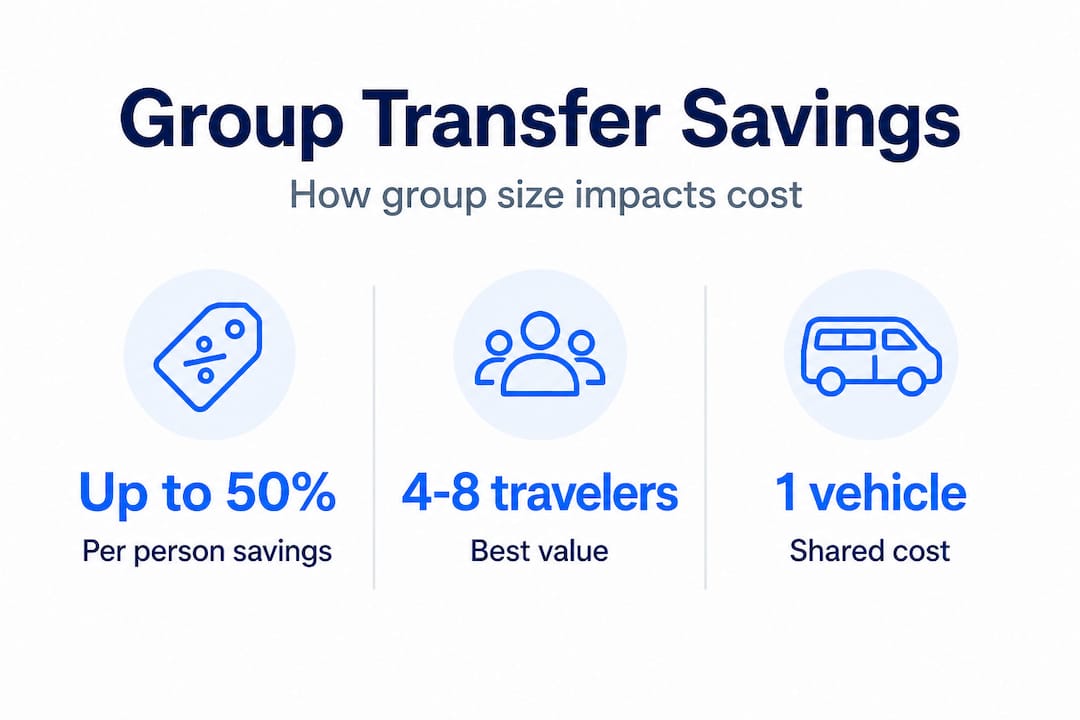
The single most powerful insight in private transfer pricing is this: transfers are charged per vehicle, not per person. This changes the maths entirely for groups. A four-person transfer at €280 works out to €70 per person. A six-person transfer in a slightly larger vehicle at €320 drops to just over €53 per person. The bigger your group, the more you save individually.
Here are the key strategies to maximise value for your group:
Fill the vehicle. If you are travelling with friends or family, consolidate into one vehicle rather than splitting across two. You will pay less per person and enjoy the journey together.
Choose the right vehicle class. A standard estate handles four passengers and typical ski luggage comfortably. If you have bulky equipment or six-plus passengers, a minibus is more practical and often not dramatically more expensive per head.
Book early, especially for peak dates. Early bookings often secure better rates and guarantee vehicle availability. Leaving it until December for a Christmas week transfer is a gamble.
Ask about flight monitoring. Premium providers track your flight in real time and adjust pick-up timing automatically. This is not just a luxury; it protects you from paying waiting time fees caused by delays outside your control.
Confirm child seat and luggage policies upfront. Declare everything when you book. Surprises at the kerbside are the worst kind.
Look for round-trip discounts. Booking your return journey at the same time as your outbound transfer frequently unlocks a meaningful saving.
Edge cases to plan for include delayed flights and waiting time policies, night or weekend travel with different tariff bands, and group size upgrades where the per-person cost can look low but the per-vehicle rate sets the actual floor. Being aware of these scenarios before you book puts you firmly in the driving seat, so to speak.
For groups specifically, group ski transfers can deliver savings of up to 50 percent compared with booking individual seats on shared shuttles. And for a step-by-step walkthrough of the booking process, the essential transfer steps guide covers everything from selecting your vehicle to confirming your drop-off point at the resort.
Vehicle upgrades are worth considering on their own merits too. A luxury vehicle with leather seating, extra legroom, and a smooth, quiet ride transforms a two-hour mountain journey into part of the holiday itself. After a long-haul flight, that comfort is genuinely valuable. The additional cost per person in a group context is often surprisingly modest.
Why anticipating inclusions beats chasing the lowest fare
Taking a step back, it is time to share a hard-learned truth from years of experience in the Alps. The traveller who books the cheapest advertised transfer does not always pay the least. And they almost never have the best experience.
Here is the uncomfortable reality. A €220 base fare that excludes tolls, charges for waiting time, and adds a peak season supplement can easily become a €310 journey. Meanwhile, a €280 all-inclusive fare from a transparent provider delivers exactly what it promises, no drama, no kerbside negotiation, no awkward conversation about who owes what.
The ski holiday itself is a dance with gravity, a poetry of motion carved into the mountain. The transfer should be the overture, not an obstacle. When your driver is already waiting as you clear customs, when the vehicle is warm and your ski bags are loaded without fuss, the holiday begins at the arrivals gate. That feeling is worth something real.
We have seen too many travellers arrive frazzled, having booked the cheapest option only to discover their driver could not wait beyond 30 minutes, or that their ski bags cost extra, or that the vehicle was not quite what was advertised. The mountain does not care about your transfer stress, but we do.
A transparent provider who details their policies candidly, who tells you upfront about night rate bands and luggage policies, is demonstrating respect for your time and your budget. That candour is itself a signal of quality. The service inclusions explained page is always worth reading in full before you commit to any provider.
Prioritise clarity. Prioritise reliability. The lowest fare is a starting point, not a destination.
Ready to book your Geneva airport ski transfer?
If you are now ready to lock in a price and secure peace of mind for your next ski holiday, we make it beautifully straightforward. At Alpy, we believe your transfer should feel like the first run of the season: smooth, exhilarating, and exactly as promised.
Browse our full range of routes and book your transfer in minutes. Whether you are heading to Val d’Isère for legendary off-piste, or carving your way down to Courchevel for the finest après ski in the Alps, we have a vehicle and a driver ready for you. All-inclusive pricing, professional drivers, flight monitoring, and child seats available as standard. Explore more premium ski transfer destinations and discover why thousands of ski travellers trust us to start their holiday the right way.
Frequently asked questions
Are Geneva airport ski transfer rates fixed or do they vary by season?
Most fixed fares are set per route, but seasonal surcharges can apply during high season, particularly in December through April, so always confirm the total fare for your specific travel dates.
Is waiting time included if my flight to Geneva is delayed?
Many private transfer providers include a waiting window for delayed flights as part of their all-in service, but exact policies differ significantly, so confirm the waiting time allowance before you book.
Does booking a larger vehicle for a group reduce the per-person price?
Yes, because transfers are priced per vehicle rather than per passenger, a larger group sharing one vehicle typically pays considerably less per person than smaller groups or individuals.
How far in advance should I book my Geneva airport ski transfer for 2026?
Book as early as possible, particularly for peak dates in December and February, when vehicle availability tightens and surcharges are at their highest across all providers.
Recommended
Comments