
Geneva airport ski transfers: 5 essential steps for 2026

Updated: May 5
TL;DR:
Book private ski transfers 3-4 weeks in advance with flight and gear details ready.
Ensure providers have proper licenses, winter tyres, snow chains, and Alpine driver training.
Arrive at your resort relaxed, with transfers lasting between 1 to 3.5 hours depending on destination.
Peak ski season at Geneva Airport is controlled chaos. Flights pour in from across Europe, families wrestle with boot bags, and the arrivals hall buzzes with the kind of frantic energy that could make even the most seasoned snow chaser break a sweat before they have touched a single slope. This is where reliable Geneva Airport Transfers make all the difference. Getting your transfer right is the key to arriving relaxed and on time. This guide walks you through every step, from booking preparation to resort arrival, so your ski holiday starts the moment you land, not the moment you finally stop stressing.
Table of Contents
Key Takeaways
Point | Details |
Book transfers early | Advance booking secures the best rates and ensures vehicle availability for your group and gear. |
Verify provider safety | Check licensing, insurance, winter tyre standards, and proper driver training for Alpine conditions. |
Meet procedures at Geneva | Your driver will track your flight and wait in the arrivals hall with a sign, ready for direct transfer. |
Expect smooth resort arrival | Transfers are direct to chalet or hotel, with tips encouraged for top service and a calm first hour. |
Premium transfers for convenience | Private transfers offer flexibility, safety, and comfort, ideal for families and ski gear-heavy groups. |
Preparing to book your ski transfer
Before you even open a booking form, you need to get organised. Think of this stage as clipping into your bindings before a run — rush it, and things go wrong fast. The single most important move? Timing. Book private transfers 3-4 weeks in advance during peak season to lock in availability and the best rates, and make sure you have your flight number ready for real-time tracking.
Here’s everything you need to gather before booking:
Flight number (essential for driver tracking and delay management)
Exact destination address (chalet name, resort, postcode)
Passenger count (adults, children, infants)
Luggage and ski gear details (number of ski bags, boot bags, helmets)
Special requirements (child seats, booster seats, accessibility needs)
Proof of accommodation and travel insurance documents
Passport details for international border crossings
Once you have all of that to hand, booking becomes genuinely straightforward. Using a clear booking forms guide helps you avoid the common mistake of forgetting gear counts, which can leave your party scrambling for boot space on arrival.
Private vs shared: what’s the real difference?
Transfer type | Typical price range | Best for |
Private transfer | €200 to €600 | Families, groups, premium resorts |
Shared shuttle | €35 to €100 per person | Solo travellers, tight budgets |
Private transfers cost more upfront, but they offer direct, door-to-door service with no detours or waiting for other passengers. For families loaded with ski gear, or anyone heading to a premium resort like Courchevel or Megève, that convenience is worth every euro. Planning stress-free ski journeys also means thinking about road conditions at your destination, which links directly to departure timing.
Pro Tip: Book a morning transfer whenever possible. Alpine roads are less congested early in the day, road treatment crews have usually completed their runs, and you’ll arrive at the resort with time to settle in before the slopes fill up.
For further planning ideas across different family setups, these airport transfer tips cover edge cases like travelling with young children and oversized equipment.
Checking provider credentials and safety standards
Not all transfer providers are created equal, especially when you’re talking about narrow Alpine switchbacks glazed with ice. Once your documents and plans are ready, scrutinise your provider carefully. Safety in the Alps is non-negotiable.
Here’s your essential provider checklist:
Valid commercial transport licence and public liability insurance
Winter tyres bearing the 3PMSF symbol (three-peak mountain snowflake) with minimum 4mm tread
Snow chains carried on board for mandatory sections
Regular vehicle inspections and maintenance records
Drivers trained specifically for Alpine winter conditions
Clear weather contingency plans for road closures or heavy snowfall
Verify provider credentials thoroughly: licensing, insurance, winter tyre standards, and driver training are the pillars of a safe Alpine transfer.
A note on snow chains: in both Switzerland and France, blue road signs indicate sections where snow chains are legally mandatory. When chains are fitted, the maximum permitted speed drops to 50 km/h. This isn’t just a legal requirement — it’s a physical one. Chains grip packed snow and ice in a way that even the best winter tyres simply can’t replicate on steeper descents. For a full breakdown of snow chain laws across European Alpine countries, check the relevant regulations before travel.
“The difference between a good Alpine transfer provider and a great one shows up in the details: are the chains actually in the boot, or just ticked on a form? Ask directly.”
Provider comparison at a glance:
Safety feature | Minimum standard | Premium standard |
Tyre rating | 3PMSF symbol | 3PMSF + tested in conditions |
Tread depth | 4mm minimum | 6mm+ |
Snow chains | Carried on board | Pre-fitted for mountain sections |
Driver training | Basic Alpine licence | Annual Alpine driving certification |
Genuine airport transfer safety tips go beyond ticking boxes. Ask your provider directly how they handle sudden weather deterioration. A confident, detailed answer is a green flag. Vague reassurance is not.
Navigating Geneva airport arrival and transfer procedures
With your provider vetted and booking confirmed, here’s exactly what to do as you arrive at Geneva airport. The process is smoother than most people expect, provided you know the steps.
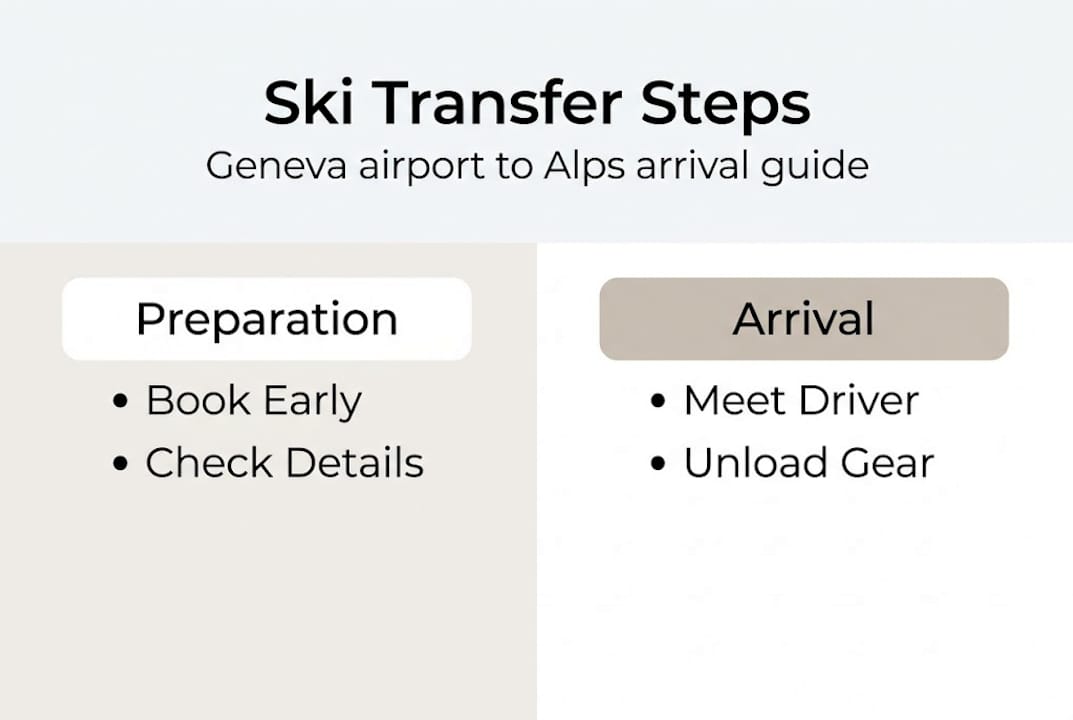
Step-by-step arrival guide:
Passport control — Follow signage for EU or non-EU lanes. Have your passport ready and boarding pass accessible.
Baggage reclaim — Check the departure board for your carousel number. Collect all bags, ski bags, and boot bags before moving on.
Customs — Standard EU/non-EU channels. Declare any items above threshold if required.
Arrivals hall — Exit through the main arrivals doors. Your driver will be waiting here, holding a sign with your name.
Driver verification — Confirm the driver’s name, company, and vehicle registration against your booking confirmation.
Loading — The driver will assist with ski gear and luggage. Check that child seats are correctly fitted if required.
Departure — Settle in, confirm your destination address verbally, and enjoy the ride.
Reputable providers use real-time flight tracking to adjust pick-up times automatically if your flight is delayed. You won’t need to frantically text anyone from the baggage carousel.
Key things to keep within easy reach:
Passport and booking confirmation
Emergency contact number for your provider
Resort address and accommodation name
Any car seat installation instructions if travelling with young children
Pro Tip: Screenshot your booking confirmation before you land. Airport Wi-Fi queues are real, and having your driver’s details offline means zero stress at the arrivals door.
If you want to coordinate airport pickup with precision, particularly for groups arriving on separate flights, planning this stage in advance is essential. For families, specific guidance on airport pickup ski holidays covers the nuances of travelling with young skiers.
What to expect during your transfer and arrival at the ski resort
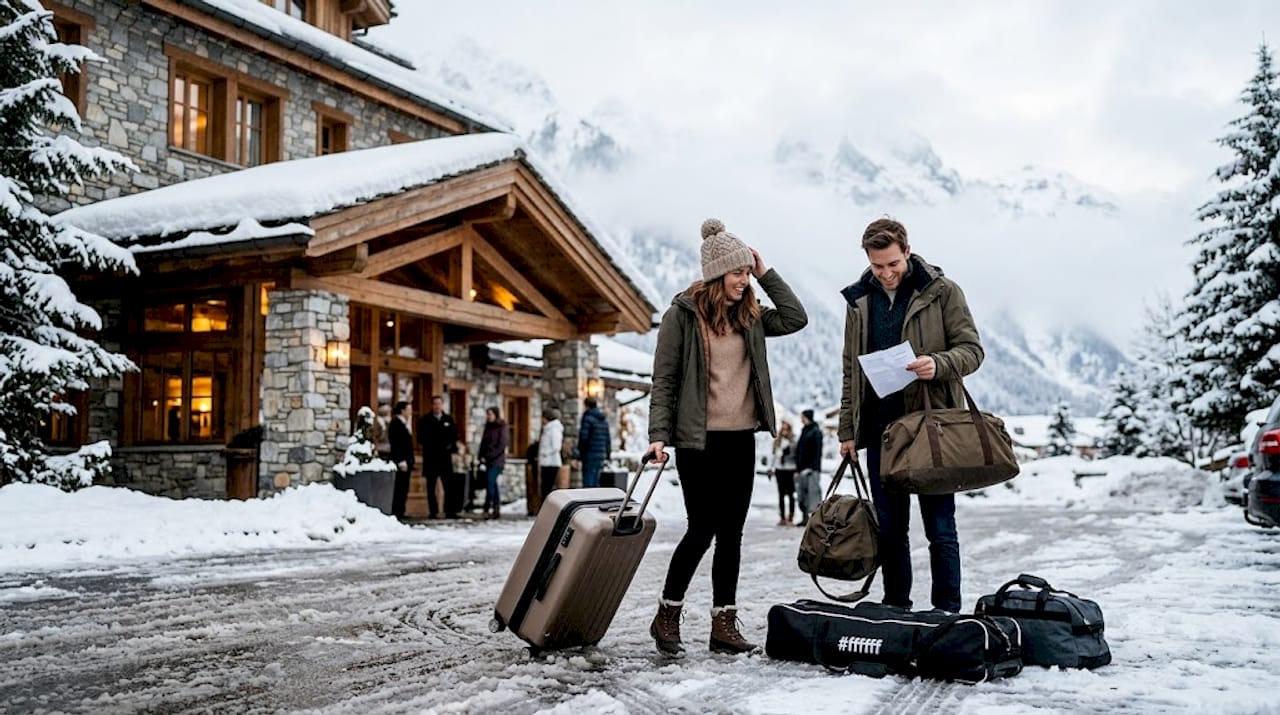
Now you’re on your way, and the Alps are starting to appear through the windscreen like a postcard coming to life. Here’s what happens between Geneva airport and your chalet doorstep.
Transfer durations by resort:
Resort | Approximate distance | Typical transfer time |
Chamonix | ~100 km | 1 to 1.25 hours |
Courchevel | ~200 km | 2.5 hours |
Val Thorens | ~230 km | 3 to 3.5 hours |
Méribel | ~195 km | 2.25 to 2.5 hours |
Transfer durations vary from roughly 1 hour for Chamonix up to 3.5 hours for Val Thorens, with border crossings from Switzerland into France typically taking just a few minutes at unmanned or lightly staffed crossing points.
Alpine roads are genuinely spectacular, but they demand respect. Your driver handles the technical work: managing speed on gradients, reading road surface changes, and adjusting for weather. Your job is to sit back and soak it in. The scenery shifts from lakeside lowlands to dramatic mountain passes, and on a clear day, it’s pure theatre.
“Every mountain road tells a different story. The switchbacks leading into Val Thorens alone are enough to remind you why this journey is part of the adventure, not just a means to an end.”
What to expect at resort arrival:
Direct drop-off at your chalet, hotel, or apartment entrance
Driver assistance with unloading all ski gear and luggage
Confirmation of return transfer details if booked
A moment to tip your driver if the service was excellent — it’s always appreciated
For those weighing up options, comparing private vs shared transfers is worthwhile, especially for larger parties where group ski transfer efficiency can make a private option significantly more cost-effective per person. Extra transfer journey tips help you make the most of the ride itself.
Expert perspective: Why premium ski travellers skip shared transfers
Here’s the honest truth: after years of watching ski travellers navigate this choice, the pattern is clear. First-timers often default to shared shuttles to save money. Experienced ski travellers book private, every single time.
It’s not about luxury for its own sake. It’s about control. A private transfer departs when you arrive, not when a shuttle accumulates enough passengers. Your gear goes in one vehicle, with you, directly to your door. No waiting in a cold car park while someone from a different flight is still at baggage reclaim.
For families with young children, or groups heading to premium resorts like Courchevel or Megève, the personalisation factor is everything. Benchmarks back this up: Alps2Alps holds a 4.6/5 Trustpilot rating from over 1,400 reviews, with punctuality consistently cited as the standout quality. That’s not a coincidence — it reflects a service model built around your schedule, not a shared one.
Pro Tip: If you’re booking for a group of four or more, price out a private transfer per person. You may find the gap with shared shuttles narrows to almost nothing, and the experience difference is enormous.
Book your premium Geneva ski transfer today
You’ve done the hard work — now make it official. Whether you’re heading to the iconic slopes of Courchevel or the charming valleys of Méribel, securing your transfer early means no last-minute scrambles and no compromise on quality.
With Alpy.eu, booking is fast, transparent, and built around you. Explore Courchevel transfers or Meribel transfers with all-inclusive pricing, professional drivers, and real-time flight monitoring baked in. Need something tailored? Use the car booking tool to customise your journey. Book now, lock in your preferred slot, and let the adventure begin the moment you land. ⛷️
Frequently asked questions
How early should I book a private ski transfer from Geneva airport?
Book 3-4 weeks ahead during peak season to guarantee availability and access the best rates — last-minute bookings risk limited vehicle options and higher prices.
What documents and details must I provide when booking?
You’ll need your flight number, resort address, passenger and luggage count, any special requirements like child seats, and proof of accommodation. A clear booking form ensures nothing is missed at the planning stage.
Are winter tyres and snow chains required for transfers in the Alps?
Yes. Vehicles must carry 3PMSF-rated winter tyres with at least 4mm of tread, plus snow chains for mandatory Alpine road sections marked by blue signs in both Switzerland and France.
What’s the usual transfer time from Geneva to top resorts?
Transfer times range from around 1 to 1.25 hours for Chamonix, approximately 2.5 hours for Courchevel, and up to 3.5 hours for Val Thorens, depending on road and weather conditions.
Is tipping the driver expected after resort arrival?
Tipping isn’t mandatory, but it’s warmly appreciated after a safe, smooth transfer, especially following long mountain drives or exceptional personalised service.
Recommended
Comments