
Make the most of day one on the slopes
- PikZiy Studio

- 12 hours ago
- 9 min read
TL;DR:
Your first day on skis requires proper preparation, including layered clothing, well-fitting boots, and essential gear to stay warm and safe. Arriving early via private transfer and starting on easy slopes helps build confidence while preventing fatigue and injury. Staying mindful of safety rules and ending each day on a high note ensures enjoyment and progress throughout your ski holiday.
First days on skis are a cocktail of exhilaration, cold air, and just enough chaos to make you question your life choices. The mountain does not care that you are excited. Knowing how to make the most of day one on the slopes is what separates people who go home buzzing with stories from those who limp off before lunch, exhausted and demoralised. This guide cuts through the noise and gives you a genuinely practical plan: from what to pack and how to dress, to technique, fatigue, safety, and getting to your resort without the stress. Day one is yours to own. 🎿
Table of Contents
Key takeaways
Point | Details |
Layer your clothing properly | Use a three-layer system with moisture-wicking fabrics to stay warm and dry throughout the day. |
Warm up before skiing | A five-minute warm-up routine before hitting the slopes reduces injury risk and improves your form. |
Focus on technique first | Spend your first 60 to 90 minutes on easy runs working on form, not covering distance. |
Rest before you feel tired | Taking breaks early prevents the fatigue that destroys technique and leads to falls. |
Plan your transfer in advance | A private transfer from Geneva or Lyon lets you arrive fresh, on time, and ready to ski. |
Gear and travel prep before you arrive
Nothing derails day one faster than arriving cold, underdressed, or two hours late because your shared shuttle got stuck behind a lorry at the Col de la Faucille. The preparation you do the night before and the morning of your first ski day determines everything that follows.
Dress for what is actually happening outside
Start with a three-layer clothing system: a moisture-wicking base layer against your skin, a mid-layer fleece for insulation, and a waterproof jacket and trousers on the outside. The one absolute rule is no cotton base layers. Cotton absorbs sweat and holds it against your body, which is a fast route to feeling genuinely cold under your layers even when you are working hard.
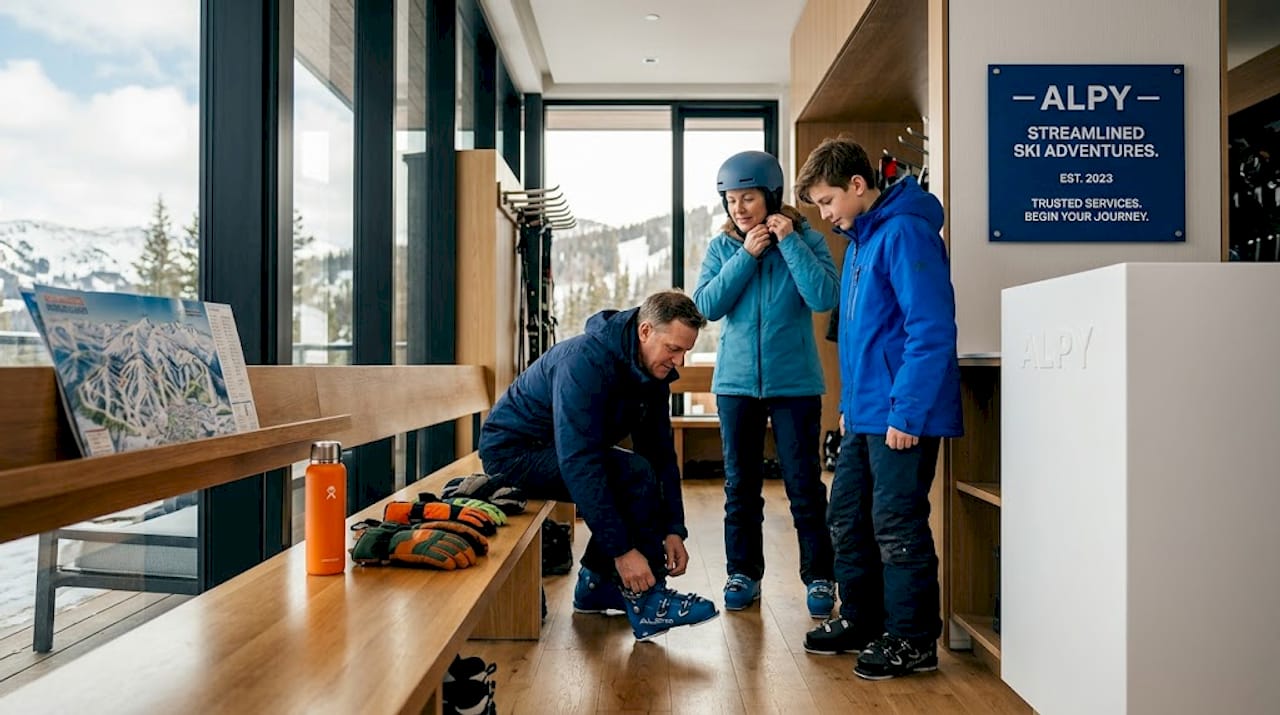
Boots deserve more attention than most beginners give them. An uncomfortable boot fit causes more early stops on day one than weather or tired legs combined. If you are hiring boots from the resort shop, say something immediately if they feel wrong. Ski hire staff can adjust the fit. Do not assume you just need to break them in.
Your other ski slope essentials include:
Goggles: Choose lenses matched to the light conditions. Well-fitted goggles that seal against your helmet reduce the airflow gap that turns a pleasant ski into a watering-eyed ordeal.
Helmet: Non-negotiable at any level. Make sure it sits level on your head with the front two fingers above your eyebrows.
Gloves: Waterproof outer shells with a warm liner. Not fashion gloves. Not touchscreen-friendly woollens.
Ski socks: Thin, tall, and specifically designed for ski boots. Regular socks bunch, crease, and cause blisters.
Snacks and water: Your body burns considerably more calories on the mountain than you expect. Pack high-energy snacks to avoid bonking mid-morning.
Pro Tip: Pack your bag the night before and set your kit out by the door. Morning chaos at a ski resort is real, and hunting for a missing glove at 7:30am is not the start you want.
Getting to the resort without the drama
Here is something the skiing for beginners guide community rarely talks about: the transfer. You can have the perfect kit, the perfect mindset, and a lesson booked at 9am, only to arrive 45 minutes late because of a delayed coach or a missed connection.
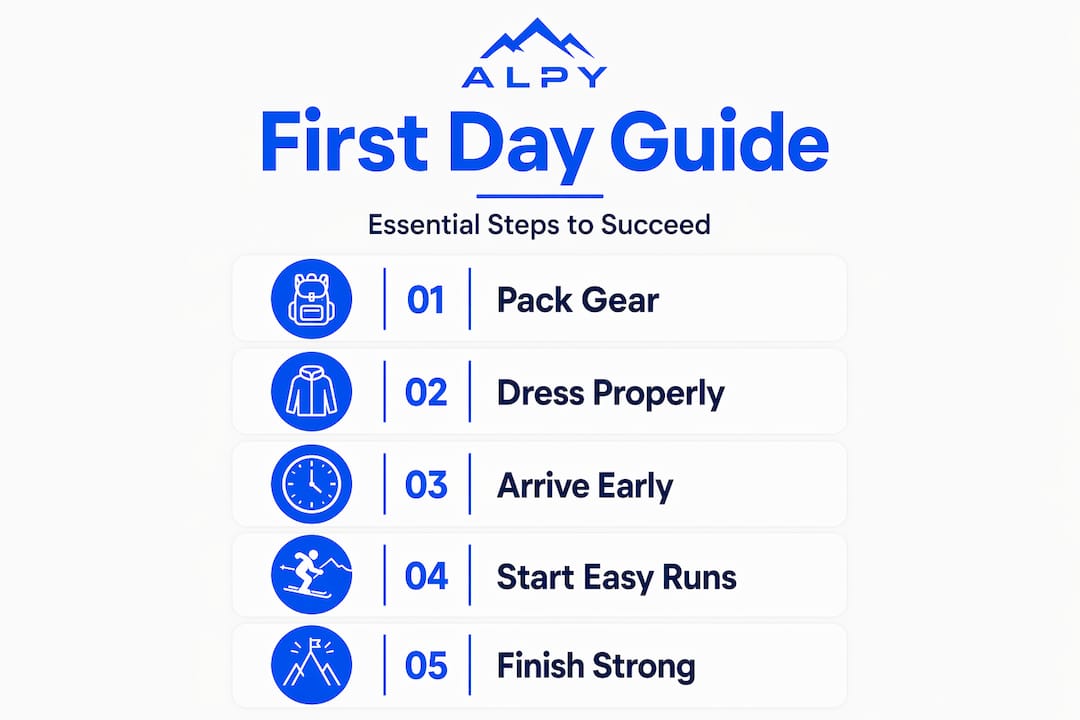
Arriving 45 to 60 minutes early for your first ski lesson is the standard advice from every instructor. That means accounting for road conditions, gear collection, and the inevitable queue at the hire shop. Alpine roads in January are not motorways. Early morning planning of waking 2 to 2.5 hours before lifts open is what gives you that unhurried, confident start.
Transfer type | Typical door-to-door time from Geneva | Key consideration |
Private transfer | Predictable, direct | Most reliable for lesson timing |
Shared shuttle | Variable, multi-stop | Risk of delays for day one |
Public transport | Longest, multi-leg | Not ideal for heavy ski gear |
Booking a private ski transfer from Geneva, Lyon, or Grenoble airports takes the chaos out of arrival day entirely. You land, your driver is there, and the next thing you see is your resort. That is the kind of start that sets the tone for everything.
Your step-by-step first day on the slopes
Right. You are geared up, you are at the resort, and the mountain is right there. Here is how to actually structure the day so that it works for you rather than against you.
Warm up for five minutes before snapping into your bindings. A short warm-up routine of bodyweight squats, reverse lunges, small lateral hops, and a few deep breaths primes your legs and reduces your injury risk. It sounds almost comically small. Do it anyway. Ski instructors who have coached thousands of first-timers swear by it.
Start on the easiest slope available. Green or blue runs are not just for children. Beginning on easy terrain gives your body a chance to rediscover movement patterns and build confidence without the added stress of gradient. Even experienced skiers returning after a long break benefit from this reset.
Spend your first 60 to 90 minutes on technique, not distance. Day one performance is built on quality repetitions. Work on your stance, your weight distribution, and your turn initiation. The mountain is not going anywhere. Chasing runs at this stage just builds fatigue and bad habits.
Master the chairlift before you queue. Sitting properly on a chairlift, keeping your skis parallel and still, and closing the safety bar promptly are procedural basics that trip up a surprising number of beginners. If you are unsure, ask the lift attendant. They genuinely do not mind. Asking is always smarter than guessing.
Know the rules of the slope before you push off. The Alpine Responsibility Code is not bureaucratic small print. Speed control, right-of-way, visible stopping, and looking uphill before moving are the behaviours that prevent collisions and keep everyone safe. You need to know these before you are moving.
Take a break after 60 to 90 minutes of skiing. Do not wait until you feel exhausted. Early breaks prevent the fatigue that turns smooth, confident turns into sloppy, injury-prone lurching. Have a hot chocolate. Eat your snacks. Watch the mountain for a few minutes.
Progress terrain gradually. Resist the temptation to follow a more experienced skier onto a black run because it looked fine from the lift. Stopping confidently and controlling your speed on a blue run is the only honest qualification for stepping up the terrain.
“Each turn on day one is a brushstroke. You are not painting a mural yet. You are learning how the brush moves.”
Pro Tip: If you are taking a group lesson, introduce yourself to your instructor at the start and tell them if anything feels uncomfortable physically. A good instructor will adapt the session for your actual comfort and ability, not a generic group average.
Common mistakes and how to stay safe skiing
The most common feeling at the end of a badly managed first day is not exhilaration. It is a quiet, grinding tiredness and the nagging sense that something could have gone better. Here is what to watch for.
Overloading on terrain. The urge to tick off as many pistes as possible is understandable. It is also counterproductive. Many beginners underestimate how quickly stabiliser muscles and the central nervous system fatigue on day one. Once that fatigue sets in, form breaks down and falls become more likely, not from a lack of skill but from pure tiredness.
Ignoring boot discomfort. If your boots hurt, deal with it immediately. Return to the hire shop. Ask for an adjustment. This is not a dramatic request. Enduring boot pain unnecessarily is one of the top reasons beginners cut their day short and dread day two.
Key safety habits to cement from the start:
Always look uphill before you start moving onto a new section of slope.
Yield to skiers already in motion below you. They have the right of way.
Stop in a visible place, never around a blind corner or directly in a run’s fall line.
After a fall, move to the side of the piste before trying to stand. Do not block the slope.
Be aware of changing weather. Flat light removes depth perception and makes reading the terrain significantly harder.
“The slope is a shared space. How you behave on it affects everyone around you. Respect that, and skiing becomes something the whole mountain enjoys together.”
Leaving the slopes while you still have energy in your legs is not a defeat. It is a strategy. Your joints, your muscles, and your enthusiasm for day two will all thank you.
Finishing strong and planning your après-ski

One of the best-kept secrets of a great ski holiday is this: the skiers who improve the fastest across a week are the ones who finish each day before they are completely spent. Leave the mountain on a high note, with your last run being one of your best, not your worst.
Plan your final run for early afternoon. Especially on day one. This leaves time for:
A proper warm-down stretch back at your accommodation before muscles tighten up.
Rehydration and a solid meal, because altitude and cold air dehydrate you faster than you realise.
Exploring the resort on foot, which is genuinely enjoyable and gives your body active recovery without impact.
Après-ski at a pace that works for you. Resorts like Morzine, Val d’Isère, and Méribel all have brilliant options from relaxed mountain bars to full après scenes. You do not have to choose between recovery and fun.
For your return to accommodation, organise your transport in advance. Round trip private transfers mean you are not scrambling for a bus at 4pm with wet ski boots and a bag full of gear. That kind of logistical comfort compounds throughout the week.
My honest take on day one skiing
Day one has beaten me up before. Not physically, but in the ego. I have arrived overconfident after a full season, skipped the warm-up, headed straight for the reds, and paid for it by noon with jelly legs and a bruised behind.
What I have learned, slowly and with some resistance, is that day one is not the day to prove anything. The mountain does not care how good you were last February. Your body needs to find its rhythm again. The skiers I have watched improve fastest across a week are always the ones who treat day one as a recalibration, not a performance.
The preparation piece matters more than most people give it credit for. When I have arrived organised, with my transfer sorted, my gear packed the night before, and a plan to start on easy terrain, everything flows. When I have wasted the morning sorting logistics, I have arrived frazzled, rushed my warm-up, and made dull mistakes I would not normally make.
My honest advice: manage the morning like a professional and ski like a student. That combination will serve you far better than the reverse.
— Rolands
Start your ski day with Alpy
Getting to the mountain should feel like the beginning of an adventure, not a test of endurance. Alpy provides door-to-door private ski transfers from Geneva, Lyon, Grenoble, and Chambéry airports to the Alps’ most beloved resorts, including Val d’Isère, Morzine, Méribel, and Courchevel.

With experienced drivers, flight monitoring, child seats, and all-inclusive pricing, Alpy takes the uncertainty out of arrival day. You arrive on time, relaxed, and ready to make every one of those first turns count. Book your transfer early to align with your lesson schedule and lift opening times. Your mountain is waiting. 🏔️
FAQ
What should I pack for my first day skiing?
Pack a three-layer clothing system with a moisture-wicking base, fleece mid-layer, and waterproof outer shell. Bring a properly fitted helmet, goggles, ski gloves, ski socks, snacks, and water.
How early should I arrive before my ski lesson?
Arrive 45 to 60 minutes before your lesson starts. This gives you time to collect hire gear, adjust your boots, and settle in without rushing.
Which slopes should a beginner use on day one?
Start on green or blue runs to build technique and confidence safely. Avoid black runs until you can stop and control your speed consistently on easier terrain.
How do I stay safe on the ski slopes?
Follow the Alpine Responsibility Code: control your speed, yield right-of-way, stop only in visible areas, and always look uphill before moving onto the piste.
How do I get from Geneva airport to a ski resort for day one?
A private transfer with Alpy from Geneva airport offers direct, door-to-door transport to resorts including Val d’Isère, Méribel, and Morzine, with flight monitoring so your driver is always there when you land.
Recommended
Comments