
Transparent pricing in ski transfers: what to expect in 2026
Updated: Apr 4

Booking a private transfer from Geneva airport to your favourite Alpine resort should feel exciting, not stressful. Yet many skiers encounter wildly different prices for seemingly identical journeys, with little explanation for the variation. Some providers advertise low rates only to add unexpected fees at checkout, whilst others adjust prices without warning based on demand. Transparent pricing eliminates this confusion by providing upfront, honest cost breakdowns that explain exactly what you’re paying for and why. Understanding how transparent pricing works empowers you to make confident booking decisions and avoid unpleasant surprises that can dampen your ski holiday before it even begins.
Table of Contents
Key takeaways
Point | Details |
Upfront clarity | Transparent pricing means all costs are disclosed before booking with no hidden fees |
Price variation factors | Distance, route complexity, demand, and booking timing all influence transfer costs |
Trust over savings | Most travellers prioritise reliability and predictability over finding the absolute cheapest option |
Dynamic pricing risks | Real-time price adjustments can confuse consumers if not clearly communicated upfront |
Early booking advantage | Securing transfers weeks in advance helps avoid last-minute price surges and ensures availability |
What is transparent pricing in ski transfers?
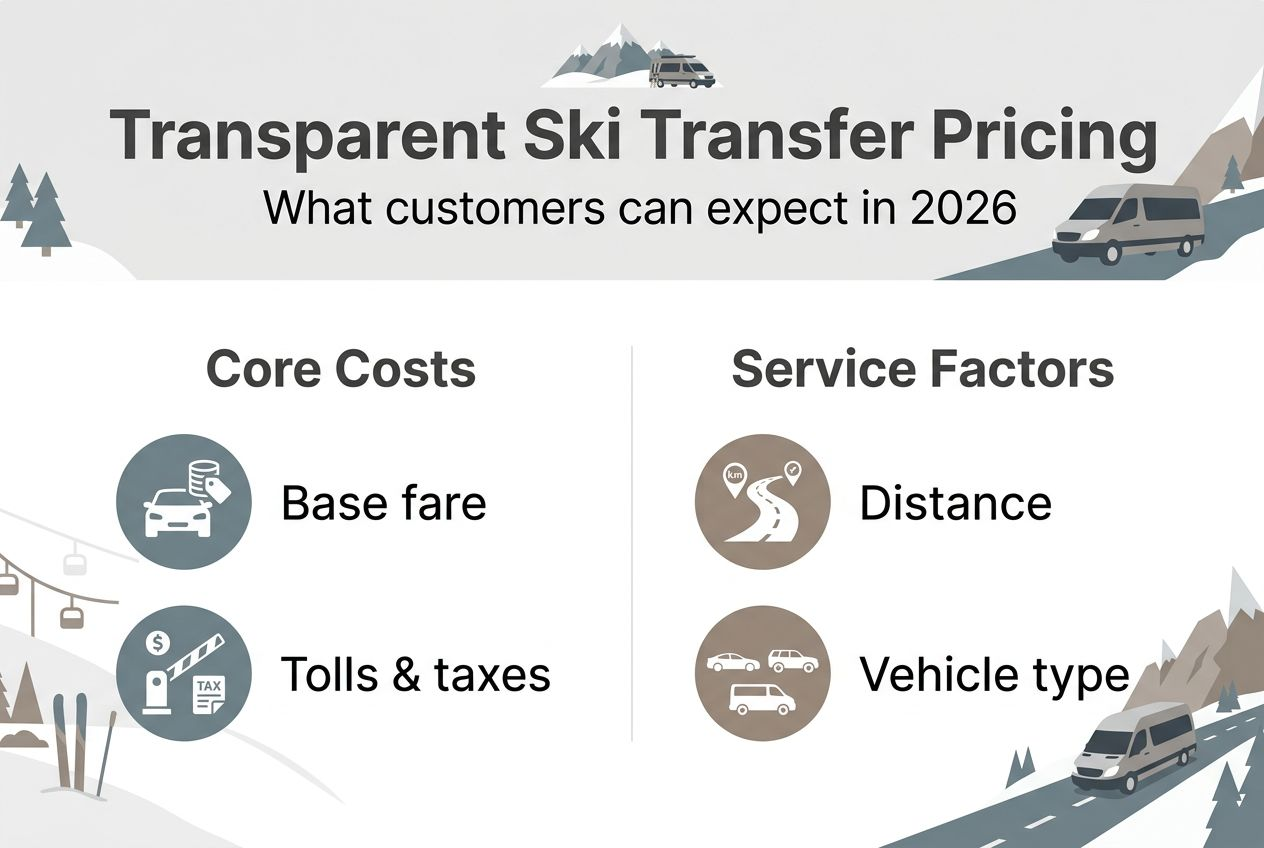
Transparent pricing represents a fundamental shift in how transfer companies communicate costs to customers. Rather than presenting a single number with vague terms and conditions, transparent pricing breaks down exactly what you’re paying for: the base fare, any seasonal adjustments, vehicle type, passenger capacity, and included services like child seats or luggage allowances. This approach ensures travellers understand the complete cost structure before committing to a booking.
The importance of transparency extends beyond simple price disclosure. When booking a cost breakdown of ski transfers key factors, you deserve to know whether the quoted rate includes motorway tolls, parking fees, waiting time, and fuel surcharges. Transparent providers explain these components clearly, whilst opaque pricing models often hide additional charges in fine print or spring them on customers at the last moment.
Consider what genuine transparency includes:
Fixed rates that don’t change between quote and booking confirmation
Detailed fare explanations covering distance, route difficulty, and service level
Clear communication about when prices might vary due to seasonal pricing ski transfers
Upfront disclosure of any potential additional costs like late-night pickups or extra stops
This contrasts sharply with opaque pricing models that employ dynamic algorithms to adjust rates without explanation. A European Consumer Organisation study highlights how hidden price increases erode consumer trust across transport sectors. As one Harvard Business School pricing expert notes, “Transparency isn’t just about listing prices; it’s about explaining the ‘why’ behind them.”
“When companies explain their pricing logic openly, customers feel respected and informed rather than manipulated. This builds loyalty that survives competitive pressure.”
Transparent pricing transforms the booking experience from a guessing game into a straightforward transaction. You know exactly what you’ll pay, what services that payment includes, and why the price reflects fair value for the journey ahead. This clarity proves especially valuable when coordinating complex travel logistics involving flights, accommodation, and equipment rental, all of which demand precise budgeting.
Why ski transfer prices vary and how transparency helps
Price differences across ski transfer routes stem from multiple concrete factors that transparent providers openly communicate. Distance represents the most obvious variable: a transfer from Geneva to nearby Chamonix naturally costs less than the journey to distant Zermatt. However, terrain difficulty adds complexity. Routes requiring mountain passes, winter tyre regulations, or chains during heavy snowfall incur higher operational costs that honest providers factor into their pricing.

Service complexity creates additional variation. Austrian resort transfers often involve longer distances and border crossings compared to French destinations. Vehicle requirements differ too: luxury minivans with ski racks and ample luggage space command higher rates than standard sedans. The Alps Transfer Index 2025 reveals an 88.5% gap in the cost per kilometre for ski resort transfers, highlighting how route characteristics dramatically impact pricing.
Dynamic pricing introduces real-time demand fluctuations that can confuse travellers when poorly communicated. Peak transfer times, such as Saturday changeover days during school holidays, see higher demand and correspondingly elevated prices. Late bookings face what industry analysts term the ‘procrastination tax’: booking two weeks later can add a 15% premium as providers fill remaining capacity at higher rates.
Transparent pricing openly communicates these factors upfront rather than surprising customers at checkout. When you request a quote, honest providers explain whether the rate reflects peak season demand, premium vehicle selection, or challenging route conditions. This clarity allows you to make informed trade-offs, perhaps choosing a midweek transfer or booking earlier to secure better value.
Route | Distance | Typical Price Range | Cost per km |
Geneva to Chamonix | 88 km | €95-€140 | €1.08-€1.59 |
Geneva to Verbier | 158 km | €180-€260 | €1.14-€1.65 |
Geneva to Val d’Isère | 215 km | €280-€380 | €1.30-€1.77 |
Geneva to Zermatt | 244 km | €320-€450 | €1.31-€1.84 |
Pro Tip: Request quotes for the same route from multiple providers during the same timeframe to identify which companies offer consistent, transparent pricing versus those using opaque dynamic algorithms that vary wildly between searches.
Understanding these variation factors empowers you to spot genuinely fair pricing. If a quote seems unusually low, transparent providers will explain whether it reflects a promotional rate, off-peak timing, or reduced service level. Fixed ski transfer prices Geneva providers eliminate guesswork by publishing clear rate cards that remain stable regardless of when you search, though they may still vary by season or passenger count.
The challenges of dynamic pricing and the demand for upfront clarity
Dynamic pricing algorithms adjust transfer fares based on real-time demand, available capacity, competitor rates, and booking timing. Airlines and hotels have employed these systems for decades, arguing they optimise revenue whilst offering lower prices during quiet periods. Applied to ski transfers, dynamic pricing theoretically rewards early planners with better rates whilst charging premium prices to last-minute bookers when demand peaks.
The advantages sound compelling:
Real-time cost reflection that matches supply and demand efficiently
Competitive pricing that responds to market conditions automatically
Potential savings for flexible travellers who can book during off-peak windows
Revenue optimisation that theoretically keeps providers financially sustainable
However, significant drawbacks emerge when dynamic pricing lacks transparent communication. Prices can fluctuate dramatically between searches, creating unpredictability that frustrates travellers trying to budget accurately. Some systems employ cookies to track repeat visitors, potentially inflating prices for customers who demonstrate strong purchase intent. Hidden price inflation concerns arise when providers use dynamic algorithms to test maximum willingness to pay rather than reflect genuine cost variations.
Consumer research reveals travellers prioritise trust and reliability over the cheapest option to avoid vacation-ruining surprises. A ski transfer represents more than simple transportation: it’s the bridge between your flight landing and your holiday truly beginning. Unreliable pricing or unexpected fees create stress precisely when you want to relax and enjoy your trip.
Some providers argue dynamic pricing is necessary to remain competitive in a fragmented market where dozens of companies vie for the same customers. Yet this commercial pressure conflicts with transparency when algorithms adjust prices without clear explanation. The most customer-focused approach combines dynamic elements with upfront clarity: clearly communicating that prices vary by season, demand, and booking timing whilst providing stable quotes that don’t change once confirmed.
“Customers don’t object to paying more during peak times if providers explain the reasoning honestly. What erodes trust is discovering hidden fees or watching prices jump without explanation.”
The cost breakdown of ski transfers key factors demonstrates how transparent providers can incorporate legitimate price variations whilst maintaining customer confidence. Rather than hiding behind opaque algorithms, they publish clear rate structures that explain exactly when and why prices adjust, allowing travellers to make informed decisions about booking timing and service selection.
How to ensure transparent pricing when booking ski transfers in Geneva
Navigating the ski transfer market successfully requires active verification rather than passive acceptance of quoted prices. Follow these systematic steps to confirm genuine transparency before committing to any booking:
Request detailed written quotes that itemise all cost components including base fare, taxes, tolls, and any potential additional charges.
Confirm explicitly whether the provider uses fixed or dynamic pricing and ask how rates might change between quote and final booking.
Verify what services the quoted price includes: luggage allowance, child seats, meet and greet service, flight monitoring, and waiting time.
Compare multiple providers using consistent criteria like passenger count, luggage requirements, and preferred travel dates to identify pricing patterns.
Check cancellation policies and amendment fees to understand total potential cost exposure beyond the base transfer price.
Read recent customer reviews focusing specifically on pricing accuracy and whether final charges matched initial quotes.
Reliable benchmarks help evaluate whether quoted prices reflect fair market value. The Alps Transfer Index provides independent cost-per-kilometre data across major Alpine routes, allowing you to spot outliers that seem suspiciously cheap or unjustifiably expensive. Unusually low quotes often indicate hidden fees ahead or substandard service quality.
The Alpine transfer market suffers from high information asymmetry and cost of trust challenges where customers struggle to verify provider reliability before booking. This fragmentation makes transparent pricing even more valuable: companies willing to openly explain their cost structures typically demonstrate broader operational integrity.
Booking transfers early delivers multiple advantages beyond potential cost savings. Peak season availability becomes constrained weeks before major holiday periods, leaving late bookers with limited options at inflated prices. Early confirmation also allows time to verify provider credentials, read reviews thoroughly, and clarify any pricing questions before your departure date approaches.
Pro Tip: Screenshot or save PDF copies of initial price quotes and booking confirmations immediately. This documentation protects you if providers attempt to adjust prices later or dispute what services were included in the original agreement.
When comparing options, consider checking established providers with transparent rate structures for popular routes. Verbier transfers from 60 EUR, Val d’Isère transfers from 49.50 EUR, and Zermatt transfers from 70 EUR demonstrate how clear pricing allows instant comparison without hidden complexity.
Look for certifications, insurance documentation, and professional memberships that indicate legitimate operations. Transparent providers willingly share these credentials because they view them as competitive advantages rather than bureaucratic obligations. Companies hiding behind vague assurances or refusing to provide detailed documentation often lack the operational standards that justify premium pricing.
Make your ski trip hassle-free with transparent transfer pricing
Planning your 2026 ski adventure deserves the confidence that comes from knowing exactly what your airport transfer will cost with no surprises waiting at checkout. Alpy.eu specialises in transparent private ski transfers from Geneva to premier Alpine resorts, publishing clear fixed rates that remain stable from quote through journey completion. You’ll find upfront pricing for popular destinations without hidden fees or last-minute adjustments.
Our service emphasises reliability alongside transparency: professional drivers, modern vehicles equipped for winter conditions, and customer support that answers pricing questions honestly before you book. Early reservation secures your preferred travel times whilst avoiding peak-season price surges that affect less organised travellers. Whether heading to Verbier, Val D’Isère, or Zermatt, transparent pricing means your transfer budget stays predictable whilst your holiday experience remains stress-free.
Frequently asked questions
What exactly does transparent pricing include in ski transfers?
Transparent pricing discloses all costs upfront including base fare, taxes, motorway tolls, parking fees, and fuel surcharges with no hidden charges added later. Providers clearly explain what services the quoted price covers such as luggage allowance, child seats, meet and greet service, and flight delay monitoring.
Why do ski transfer prices vary so much between providers?
Prices differ based on route distance, terrain difficulty, vehicle type, service quality, and whether providers use fixed or dynamic pricing models. Operational factors like professional driver wages, vehicle maintenance standards, and insurance coverage also influence rates, with transparent providers explaining these cost components openly.
How can I tell if a ski transfer quote is genuinely transparent?
Genuine transparency includes itemised cost breakdowns, clear explanations of what services are included, explicit statements about fixed versus dynamic pricing, and written confirmation that quoted prices won’t change before your journey. Providers should willingly answer detailed questions about their pricing structure without evasive responses.
When should I book ski transfers to get the best transparent pricing?
Booking six to eight weeks before your travel date typically secures optimal rates whilst ensuring good availability, though transparent providers maintain consistent pricing structures regardless of booking timing. Last-minute bookings often face premium charges due to limited capacity, so early planning benefits both cost and peace of mind.
Does transparent pricing mean I’m paying more than dynamic pricing?
Not necessarily. Transparent fixed pricing eliminates the risk of price surges during peak demand periods that dynamic systems exploit. Whilst dynamic pricing might occasionally offer lower rates during quiet periods, transparent pricing provides budget certainty and often delivers better value when accounting for included services and reliability.
What questions should I ask providers to verify pricing transparency?
Ask for itemised quotes showing all cost components, confirm whether prices are fixed or variable, request clarification on cancellation fees, verify what services are included versus optional extras, and inquire about potential additional charges for circumstances like flight delays or extra stops. Transparent providers answer these questions directly and comprehensively.
Recommended
Comments