
Val d'isère transfer tips: beat delays in 2026

TL;DR:
A stress-free transfer to Val d’Isère depends on timing, transport choice, and understanding local infrastructure.
Optimizing arrival times, booking private transfers, and using La Daille facilities help ensure a smooth journey without delays.
A stress-free transfer to Val d’Isère is defined by three decisions: when you travel, how you travel, and how well you know the route. The Geneva to Val d’Isère transfer covers approximately 180 km and takes 3 to 3.5 hours under normal winter conditions. GPS apps will cheerfully suggest 2 hours 45 minutes. They are wrong. Alpine weather, the notorious RN90 corridor through the Tarentaise valley, and peak-season holiday traffic all conspire to stretch that estimate. These Val d’Isère transfer tips for avoiding delays and getting there stress-free give you the timing strategies, transport comparisons, and local knowledge to arrive with energy left for the mountain. Val d’Isère itself rewards the effort: 300 km of pistes, the legendary Bellevarde face, and après-ski that runs from the Folie Douce to the village’s cosy bars.
What are the best timing strategies for avoiding transfer delays?
Timing your Geneva Airport arrival is the single most powerful tool for a smooth journey to Val d’Isère. Mid-morning arrivals around 10:00–11:30 let you clear the airport, load ski bags, and hit the road before the afternoon wave of transfers clogs the Tarentaise. You reach the resort before darkness falls over the Iseran massif. That matters more than it sounds: driving into Val d’Isère in daylight, with the Solaise and Bellevarde peaks glowing above you, is genuinely part of the experience. ️
The worst days on the road are predictable. February school holidays in France, the UK, and the Netherlands overlap and send tens of thousands of skiers up the same valley simultaneously. Black Saturday, the traditional changeover day at the end of January and throughout February, is the peak of the peak. Congestion on RN90 between Albertville and Moûtiers can stretch up to 24 km, adding 39 minutes to that section alone. That delay cascades all the way to Val d’Isère.
Here is how to protect your schedule:
Fly in on a Thursday or Friday rather than Saturday to sidestep the worst changeover traffic entirely.
Book a 10:00–11:30 landing at Geneva Airport (GVA) to depart the city before the afternoon rush builds.
Avoid Sunday afternoon returns from the resort, when outbound traffic from multiple Tarentaise resorts merges on the same road.
Add 45 minutes of buffer on any Saturday departure from Val d’Isère to avoid missing your flight.
Monitor Bison Futé, France’s official traffic forecast service, in the week before travel for colour-coded congestion alerts.
Pro Tip: Book your return transfer at least 30 minutes earlier than you think you need. The mountain will still be there next season. Your flight will not wait.
Which transfer options give the most reliable journey?
Private transfers, shared shuttles, coaches, and the train-plus-shuttle combination each suit a different type of traveller. Knowing the difference saves you time, money, and frustration. For a detailed breakdown of Geneva winter transfer options, the comparison below covers the essentials.
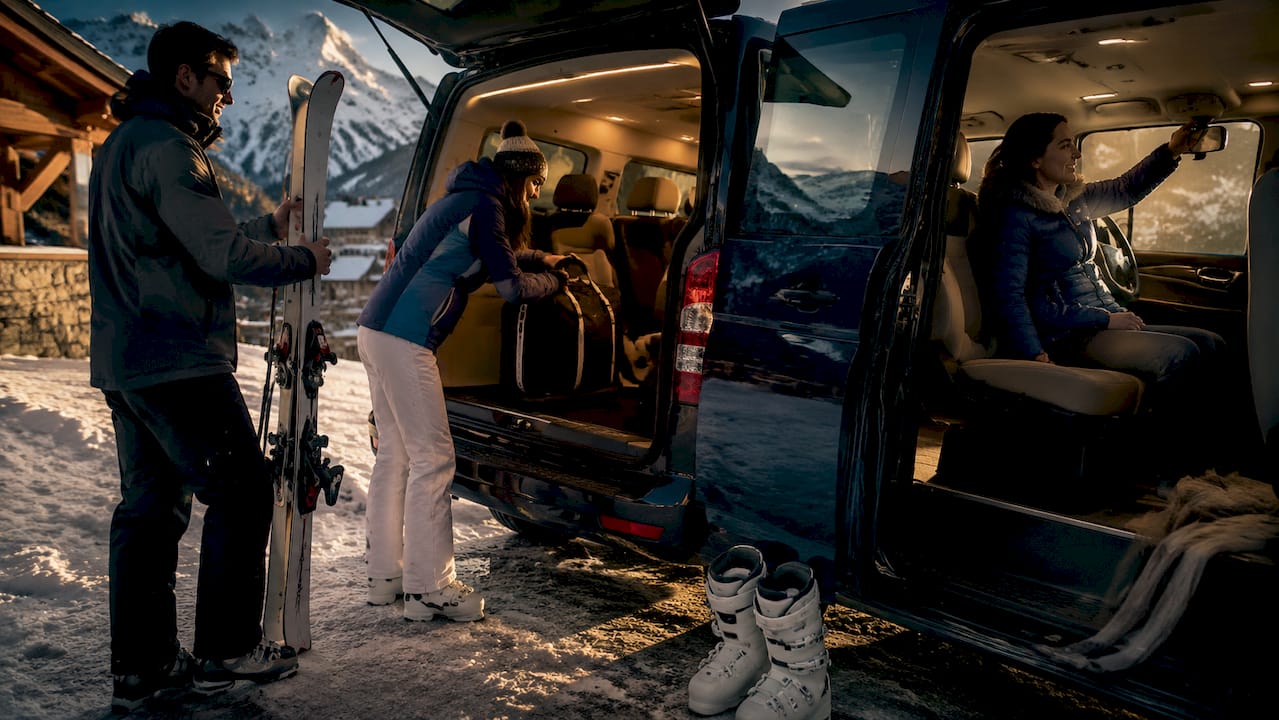
Private transfers minimise travel time with no intermediate stops and provide a warm vehicle with space for ski bags, boot bags, and poles. They are the strongest choice for families, groups of three or more, and anyone travelling with young children. The upfront cost is higher per head than a coach, but when split across a group it becomes genuinely competitive. Alpy offers private transfers to Val d’Isère from €49.50, with all-inclusive pricing and flight monitoring built in.
Transfer Type | Typical Cost (per person) | Travel Time | Luggage Handling | Best For |
Private transfer | €49.50+ | 3–3.5 hrs | Door to door | Families, groups |
Shared shuttle | €30–€45 | 3.5–4.5 hrs | Central drop-off | Solo travellers, couples |
Coach (e.g. Altibus) | €25–€35 | 4–5 hrs | La Daille bus station | Budget travellers |
Train + shuttle | €40–€60 | 5+ hrs | Multiple transfers | Enthusiasts with time |
Shared shuttles cost less but require waiting for other passengers to clear customs and baggage reclaim. They also typically drop at a central point in Val d’Isère rather than your accommodation door. That is fine in summer. In winter, dragging ski bags across an icy village is nobody’s idea of a good start to a ski holiday.
Coach services such as Altibus and Flixbus run scheduled routes to La Daille bus station. They are reliable and affordable, but the schedule is fixed. If your flight lands late, you miss your coach and face a long wait or an expensive taxi. The train option, travelling by TGV to Bourg-Saint-Maurice and then connecting by shuttle, is genuinely scenic and works well for travellers without mountains of gear. For most skiers flying into Geneva, it is simply too slow and too complicated.
How does la daille bus station help you arrive without stress?
La Daille bus station is the arrival and departure hub for long-distance coaches serving Val d’Isère from Geneva and Lyon. The station provides dedicated platforms for each coach operator, which removes the guesswork of finding your service on a busy Saturday morning. Knowing this hub exists, and knowing what it offers, turns a potentially chaotic arrival into a calm one.
The facilities at La Daille are more generous than most travellers expect:
Luggage lockers in two sizes: medium (40×50×98 cm) at €8 per day and large (80×50×98 cm) at €12 per day, bookable online or at the terminal.
Heated waiting areas with free Wi-Fi, so you can sort accommodation details or check the piste report while you wait.
Ski pass machines on site, letting you collect your lift pass before you even reach the village.
Toilets and vending machines for the inevitable post-journey coffee.
Opening hours: 06:00–22:00 on weekdays, 24 hours at weekends.
Pro Tip: Book your luggage locker online before you travel. On peak Saturdays, lockers fill up fast. Securing one in advance means you can drop your bags, grab a coffee, and connect to the village shuttle without hauling everything with you.
Using La Daille’s luggage lockers is particularly useful if your accommodation check-in is not until mid-afternoon. Rather than standing in a hotel lobby with six bags, you store everything, ride the connecting shuttle into the village, and collect your gear when the room is ready. The red train line and connecting shuttle buses run regularly between La Daille and the village centre, making the final leg of your journey quick and easy.
What winter driving rules should every val d’isère traveller know?
Winter driving on the route to Val d’Isère is governed by rules that protect everyone on the road, including you. Understanding them prevents both legal trouble and unnecessary delays.
Fit winter tyres or carry snow chains. French Mountain Law makes winter equipment mandatory on alpine routes during winter months. Winter tyres or snow chains are required by law, and police do check. Non-compliance means a fine and a forced stop at the worst possible moment.
Respect the RECITA traffic regulation system. The RECITA system manages flow on RN90 via traffic lights near Moûtiers and Aigueblanche. When you see a red light on an open road, it is not a malfunction. It is a controlled safety measure releasing vehicles in managed batches to prevent pile-ups further up the valley.
Trust official road signage over GPS. Navigation apps frequently suggest shortcuts via minor roads that are either uncleared, unsalted, or simply dangerous in winter conditions. Follow the signed route and let the traffic management system do its job.
Drive gently and increase following distance. Snow and ice compress stopping distances dramatically. Smooth acceleration, early braking, and a gap of at least four seconds to the vehicle ahead are the basics of safe alpine driving.
Plan for Saturday directionality. Peak congestion patterns on Saturdays are directional: inbound traffic peaks in the morning, outbound in the afternoon. Travelling against the flow, arriving on a Friday evening or departing on a Sunday morning, cuts your exposure significantly.
“Tarentaise traffic delays are controlled safety measures, not random jams. Travellers who understand this arrive calmer, drive safer, and reach the resort in better shape for the mountain.”
The most important mindset shift is patience. The Tarentaise valley has one main road in and one main road out. There is no clever workaround. The drivers who arrive calmest are the ones who planned for the delay, built in the buffer, and treated the drive as the start of the adventure rather than an obstacle to it.
Key takeaways
A stress-free transfer to Val d’Isère depends on timing your travel correctly, choosing the right transfer type, and understanding the local infrastructure before you arrive.
Point | Details |
Fly mid-morning | Aim for a 10:00–11:30 Geneva landing to beat afternoon Tarentaise congestion. |
Choose private for groups | Private transfers cost more per head but deliver door-to-door service with no waiting or central drop-offs. |
Use La Daille facilities | Book luggage lockers online in advance to manage bags freely on arrival day. |
Respect winter equipment law | French Mountain Law requires winter tyres or snow chains; non-compliance causes fines and delays. |
Avoid Black Saturday | February changeover Saturdays add up to 39 minutes on RN90 alone; travel Thursday or Friday instead. |
Why i always tell skiers to book the transfer before the ski pass
I have spoken to hundreds of skiers who spend weeks researching piste maps, boot fittings, and après-ski bars, then book their transfer the night before departure. That is the wrong order. The transfer is the first physical experience of the holiday. If it goes badly, the whole trip starts on the back foot.
My honest advice: book a private transfer early, especially for the Geneva to Val d’Isère route. The road through the Tarentaise is spectacular and genuinely enjoyable when you are in a warm, comfortable vehicle with a driver who knows every bend. It becomes miserable when you are crammed into a shared coach that stopped three times before you even left the Geneva suburbs.
Mid-morning arrivals are not just a timing trick. They give you the daylight drive through the Isère gorge, the first glimpse of the Bellevarde above the treeline, and the full sensory hit of arriving at a world-class ski resort in winter. That is worth protecting.
Know your hub. La Daille bus station is underrated as a resource. The locker system alone has saved more than a few holidays I know of, when accommodation was not ready and families had nowhere to put their gear. Use it.
Finally, stay calm on the road. The RECITA lights, the slow convoys near Moûtiers, the Saturday queues: they are all part of the same system keeping the valley safe. The mountain is not going anywhere. Every turn you carve on Bellevarde or shred through the powder of the Face de Bellevarde will be worth the wait.
— Rolands
Start your val d’isère holiday the right way with Alpy
The drive to Val d’Isère should feel like the opening act of something brilliant, not a battle against traffic and uncertainty. Alpy provides private ski transfers to Val d’Isère from €49.50, with experienced drivers who know the Tarentaise route in every condition, vehicles equipped for ski gear, and flight monitoring so your driver is always there when you land. No waiting, no central drop-offs, no surprises.
Booking takes minutes via the Alpy platform. You select your pickup point at Geneva Airport, your accommodation in Val d’Isère, and your travel time. All-inclusive pricing means no hidden extras. Round-trip discounts apply automatically. Whether you are travelling solo, as a couple, or with a full family and enough ski bags to fill a small chalet, Alpy has the right vehicle ready. Book your transfer now and start the holiday the moment you land.
FAQ
How long does the geneva to val d’isère transfer take?
The Geneva to Val d’Isère transfer takes 3 to 3.5 hours under normal winter conditions, covering approximately 180 km. During peak periods such as February school holidays, delays on RN90 can add 45 minutes or more.
What is the best day to travel to val d’isère to avoid traffic?
Thursday and Friday arrivals avoid the worst of the Saturday changeover congestion in the Tarentaise valley. Black Saturday during February school holidays is the single busiest day on the route.
Are winter tyres required for the drive to val d’isère?
Yes. French Mountain Law requires all vehicles on alpine routes to carry winter tyres or snow chains during winter months. Police enforce this rule, and non-compliance results in fines and forced stops.
What facilities does la daille bus station offer?
La Daille bus station provides luggage lockers (€8–€12 per day), heated waiting areas, free Wi-Fi, ski pass machines, and connecting shuttle services to the village centre. It is open 06:00–22:00 on weekdays and 24 hours at weekends.
Is a private transfer worth it for a group travelling to val d’isère?
For groups of three or more, a private ski transfer is cost-competitive with shared shuttles and delivers door-to-door service with no waiting, no intermediate stops, and full space for ski equipment.
Recommended
Comments