
How to get from Geneva Airport to the Alps without stress

TL;DR:
Proper planning for transfers from Geneva Airport to the Alps ensures a relaxed start to your ski holiday, especially during peak season.
Choosing private transfers, early booking, and preparing all travel documents and gear logistics prevent stress and optimize your trip experience.
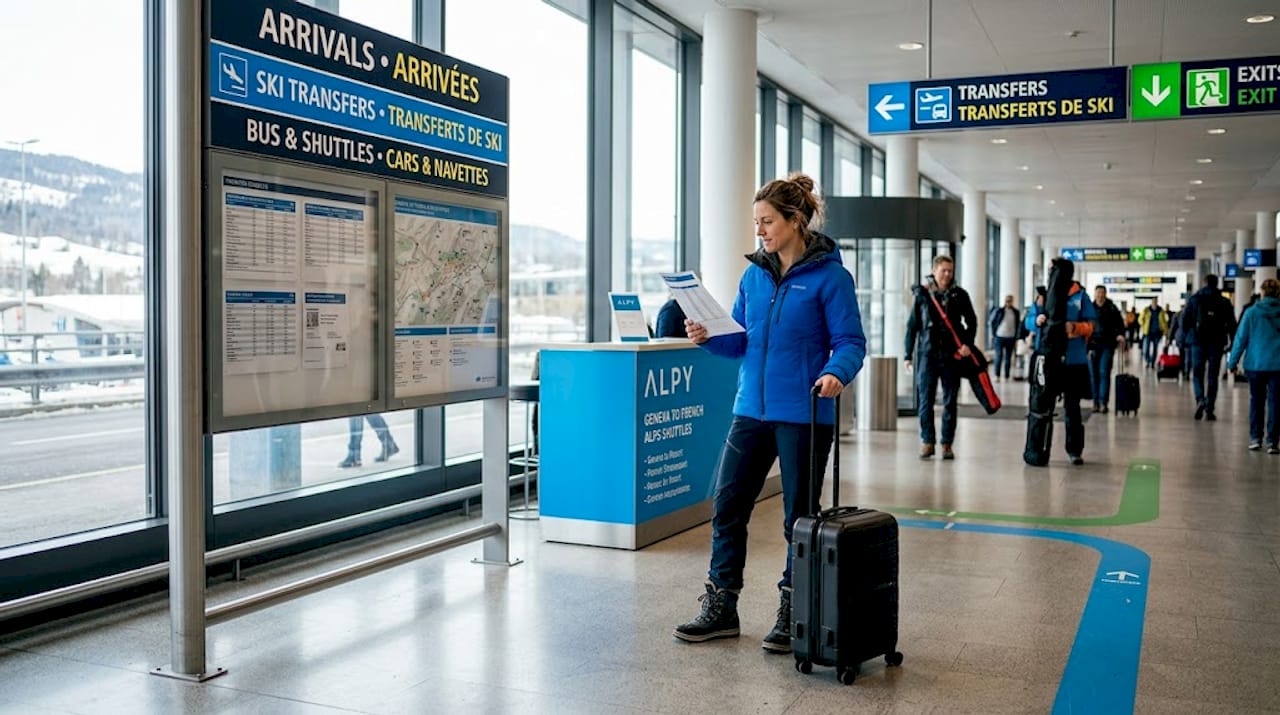
You’ve landed at Geneva Airport. The mountains are calling, the snow is waiting, and all you want is to get there. But between the luggage carousels, the ski bags, the kids, and the confusing signs pointing in sixteen directions, the transfer from airport to resort can feel like the hardest run of the trip before you’ve even clicked into your bindings. Knowing how to get from Geneva Airport to the Alps without stress comes down to one thing: planning it properly before you arrive. This guide covers everything, from transport options and booking tips to common mistakes that catch travellers out every winter season.
Table of Contents
Key takeaways
Point | Details |
Book transfers early | Peak season transfers sell out between December and March; secure yours weeks in advance. |
Private transfers suit families | Door-to-door private transfers handle ski gear and children’s needs far better than public connections. |
Budget option exists | Train plus shuttle costs around €25 per person but requires connection planning and added journey time. |
Avoid airport ATMs | Withdraw cash after the border crossing or at your resort for far better exchange rates. |
Arrival prep matters | Have your flight details, passenger count, and luggage specifics ready when booking any transfer. |
Preparing for your Geneva Airport to Alps transfer
Getting this transfer right starts at home, not at the airport. The travellers who arrive relaxed are almost always the ones who sorted the details before departure.
Here is what to prepare:
Travel documents: All passengers need valid passports or national ID cards. Switzerland is not in the EU but is part of the Schengen zone, so border crossings between Switzerland and France are generally straightforward. That said, carry documents at all times.
Travel insurance: Ski-specific insurance covering medical evacuation and equipment loss is non-negotiable for Alpine trips. Sort this before you fly.
Ski gear logistics: Decide in advance whether you are bringing your own skis or hiring at resort. Travelling with a full set of ski bags, boots, and poles adds real complexity to public transport. Private transfers handle this far more gracefully.
Currency: Avoid Geneva Airport ATMs due to poor exchange rates and high fees. Withdraw Swiss francs or euros after you cross into France or once you reach your resort.
Pre-book your transport: Do not leave this to chance. Peak season winter transfers between Geneva Airport and Alpine resorts often sell out entirely. Booking weeks ahead is not overcautious. It is simply sensible.
Pro Tip: When booking a private transfer, have your flight number ready. Reputable providers monitor arrivals and adjust pick-up times automatically if your flight is delayed, saving you a frantic phone call from baggage reclaim.
Your transport options compared
There is no single “right” answer for how to reach the Alps from Geneva. The best transport from Geneva to Alps depends on your group size, budget, luggage load, and how much flexibility you want. Here is an honest breakdown.
Private transfers
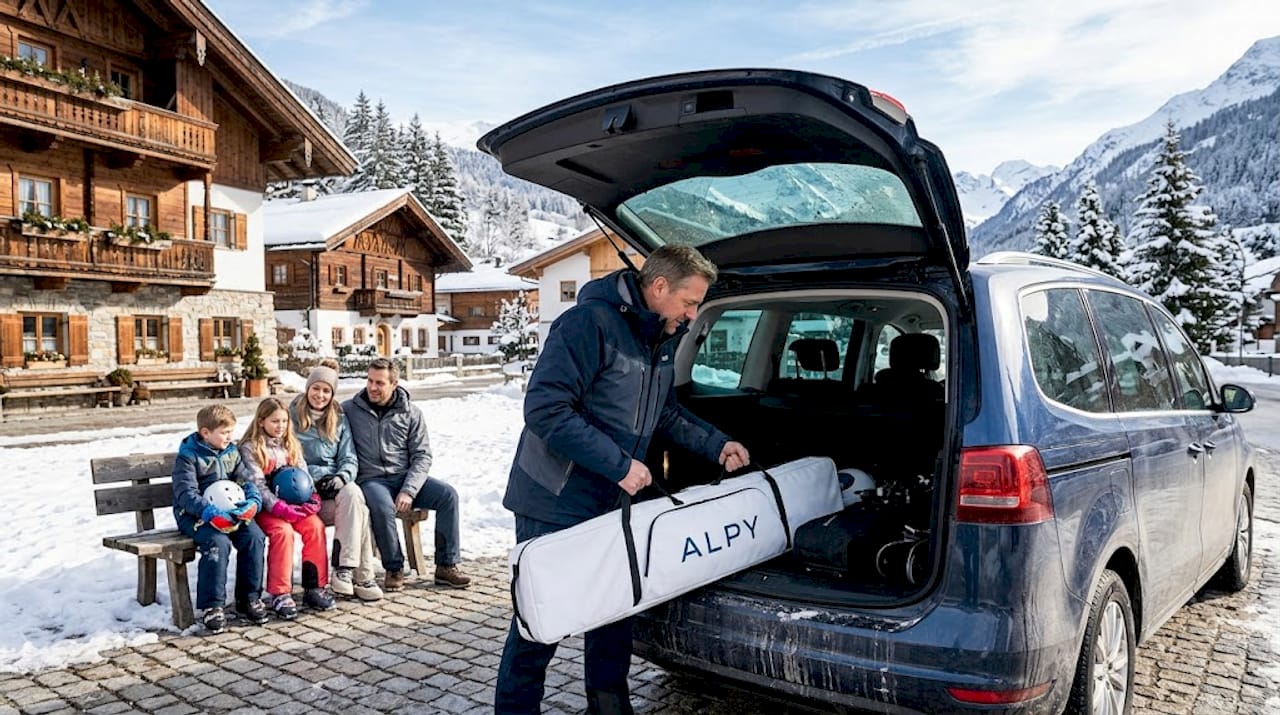
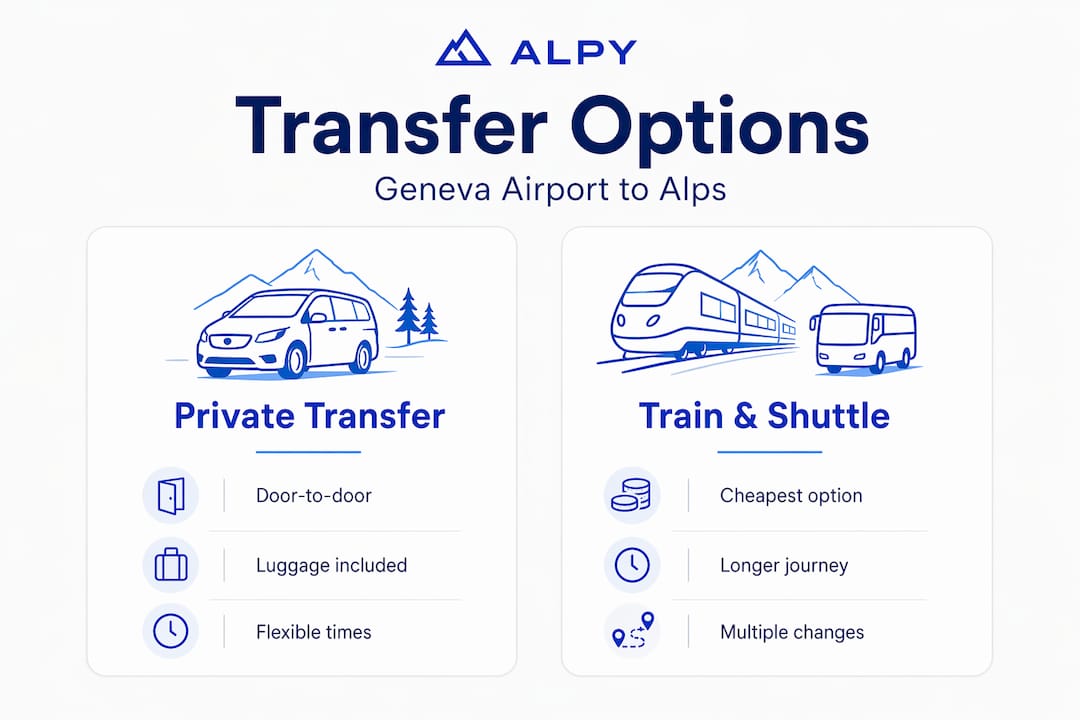
This is the gold standard for skiers, families, and groups. A professional driver meets you at arrivals, loads your ski bags, and takes you door-to-door to your chalet or hotel. No connections, no timetables, no hauling gear up and down station steps. Private transfers provide secure, direct travel from Geneva Airport to resorts, bypassing the complexity of public transport entirely. For families with young children, dedicated trailers for bulky equipment and personalised service make the difference between a smooth start and a chaotic one.
Shared shuttles
Shared shuttle services group multiple passengers heading to the same area. They are cheaper than private transfers but less flexible. You may wait at the airport for the shuttle to fill, and you will likely stop at multiple drop-off points before reaching yours. During peak season, they get busy fast.
Train plus shuttle
The Léman Express train to Cluses or Thonon-les-Bains takes approximately one hour at around €15, followed by a roughly 30-minute shuttle costing €10, bringing the total to around €25 per person. That is a genuine saving for budget travellers. The train from Geneva Airport to Genève-Cornavin station takes just seven minutes and runs every 10 to 15 minutes, making onward connections accessible. The drawback is connection timing and the physical effort of managing ski gear across multiple vehicles.
Car hire
Hiring a car offers freedom, but Alpine winter driving is not for the faint-hearted. Snow chains or winter tyres are legally required on many mountain roads, and parking at resort can be expensive and scarce. Factor in fuel, tolls, and the stress of driving in blizzard conditions before committing.
Option | Cost per person (approx.) | Journey time | Best for |
Private transfer | €45 to €120+ | 1.5 to 2.5 hrs | Families, groups, ski gear |
Shared shuttle | €25 to €50 | 2 to 3.5 hrs | Solo travellers, couples |
Train plus shuttle | ~€25 | 2 to 3 hrs | Budget travellers |
Car hire | €60 to €100 per day | 1.5 to 2.5 hrs | Flexible, confident drivers |
Pro Tip: Groups of four or more travelling together will almost always find that a private transfer costs less per person than a shared shuttle once you factor in luggage, waiting time, and the drop-off flexibility.
How to book a private transfer step by step
Booking a private ski transfer is straightforward when you know what information to have ready. Follow this process and the logistics practically look after themselves.
Choose a reputable provider. Look for providers with flight monitoring, all-inclusive pricing, and clear cancellation policies. Check how to book ski transfers from Geneva for a practical guide on what to look for.
Gather your travel details. You will need your inbound flight number, arrival time, full passenger count (including children and infants), number of ski bags or snowboard bags, and your resort destination with the specific address or accommodation name.
Book as early as possible. For December to March travel, four to six weeks ahead is a reasonable minimum. Popular resorts like Verbier, Val d’Isère, Méribel, Courchevel, and Chamonix fill up fast.
Confirm the meeting point. Most private transfer drivers meet arrivals in the designated meeting area at the terminal, holding a sign with your name. Confirm this exact location when your booking is confirmed.
Check what is included. All-inclusive pricing should cover all ski equipment, child seats (if requested), and motorway tolls. Ask explicitly so there are no surprises at drop-off.
Save the driver’s contact number. Store it on your phone before you board your outbound flight. If you have a connection delay or baggage issues, a quick message keeps everyone calm.
The types of ski transfers from Geneva to premier resorts vary, but the booking process above applies broadly across all private options.
Common mistakes and how to avoid them
Even experienced Alpine travellers make these errors. Knowing them in advance is half the battle.
Last-minute booking. This is the most common mistake. Common pitfalls include last-minute booking and relying on public transport during peak times, which worsen stress significantly. Book the moment your flights are confirmed.
Assuming public transport will work with ski gear. Trains and trams were not designed for two ski bags, a boot bag, and a toddler. The hub-and-spoke approach to Alpine travel works beautifully once you are at resort, but getting there with all your kit is a different matter.
Underestimating journey time. Mountain roads in winter take longer than Google Maps suggests. Add buffer time, especially for evening arrivals when icy roads slow traffic considerably.
Not having documents to hand at the border. Schengen crossings are generally quick, but drivers may still be asked to present passenger ID. Have everything in an easy-access pocket, not buried in a suitcase.
Ignoring Alpine weather packing. Layering is everything in the mountains. Pack thermals, a waterproof outer layer, and proper ski socks in your carry-on rather than your checked luggage, in case bags are delayed.
“The transfer is the overture to the whole ski holiday. Get it right and the mood is set. Get it wrong and you arrive tired, cold, and frustrated before the first run.”
All-inclusive packages that bundle transport, lift tickets, and accommodation exist for families who want to remove every logistical variable from the equation. They are not for everyone, but for first-time Alpine travellers with young children, the reduction in decision fatigue is real.
What to expect on arrival at your resort ️
You are in the car, the mountains are rising outside the window, and your resort is getting closer. Here is what happens next.
Drop-off point: Your driver will take you to your specified accommodation address. Confirm this with them at the start of the journey if anything has changed.
Ski equipment check: Once your bags are unloaded, count everything before the driver departs. Skis, poles, boot bags, and any pushchairs should all be accounted for.
If there is a delay: A good transfer provider will have already monitored your flight. If road conditions cause an unexpected delay during the drive, your driver will communicate clearly.
On-site orientation: Most resort reception areas are well signed. If your accommodation is on a pedestrianised street, your driver will drop you as close as physically possible and advise on the final short walk.
Local transport within resort: Most Alpine resorts have free ski buses connecting villages, lifts, and accommodation. Pick up a resort map on arrival and identify the nearest bus stop to your chalet.
Settle in and switch off. You have done the hard part. The mountain is right there, the powder is waiting, and tomorrow the dance with gravity begins.
My honest take on Alpine airport transfers
I’ve watched people arrive at ski resorts in genuinely terrible moods, not because of anything that happened on the mountain, but because the transfer was a nightmare. Delayed shuttles, missed connections, arguments over ski bags at the train station. It sets the wrong tone entirely.
In my experience, the biggest mistake travellers make is treating the transfer as an afterthought. They spend weeks choosing the right ski resort, booking the best chalet, comparing lift pass prices, and then leave the transport to chance. The irony is that a private transfer from Geneva Airport often costs less per head than people assume, particularly for groups of four or more.
What I’ve learned is that the family ski transfer experience is genuinely transformed by going private. When you have children who are already over-excited and over-tired, the last thing you want is a series of connections, a platform change, and a shared shuttle with strangers’ luggage blocking the aisle.
Multi-modal transport is perfectly viable for two adults travelling light in spring. For a family of four with ski bags in December? It is a recipe for a frazzled arrival. My advice: spend the extra money on the transfer, save it elsewhere, and arrive at that resort with your energy intact. The first run down a crisp, sunlit piste is worth every penny when you get there smiling.
— Rolands
Start your ski holiday the right way with Alpy
You have spent months looking forward to this trip. The last thing you want is to spend the first three hours of it hauling ski bags across railway platforms.
Alpy offers private door-to-door transfers from Geneva Airport to the Alps’ most beloved resorts, including Verbier transfers, Val d’Isère, Méribel, Courchevel, Zermatt, and La Plagne. Every booking includes flight monitoring, experienced professional drivers, modern winter-ready vehicles, and all-inclusive pricing with no hidden extras. Child seats are available on request. The online booking form takes minutes: select your pick-up point, drop-off location, travel date, and passenger details, and Alpy handles everything from there. Round-trip bookings come with a discount, making the decision even easier. Your holiday starts the moment you land. Let Alpy make sure it starts well.
FAQ
How long does it take to get from Geneva Airport to the Alps?
Journey times vary by resort. Chamonix takes roughly 1.5 hours, while resorts like Val d’Isère or Verbier can take 2.5 hours or more depending on road and weather conditions.
What is the cheapest way to travel from Geneva Airport to ski resorts?
The train plus shuttle combination costs around €25 per person, making it the most budget-friendly option, though it requires connection planning and more time.
Should I book my transfer in advance?
Yes, absolutely. Peak season transfers between December and March frequently sell out, and last-minute bookings risk leaving you stranded at the airport or facing very limited options.
Are private transfers worth it for families with ski gear?
Private transfers are particularly well-suited for families. Some providers offer dedicated trailers for bulky equipment and can accommodate child seats, making the journey significantly easier than public transport.
Do I need to carry my passport for the Geneva to French Alps transfer?
Switzerland is part of the Schengen zone, so border crossings into France are usually straightforward. However, carrying a valid passport or national ID card is strongly recommended at all times during travel.
Recommended
Comments